
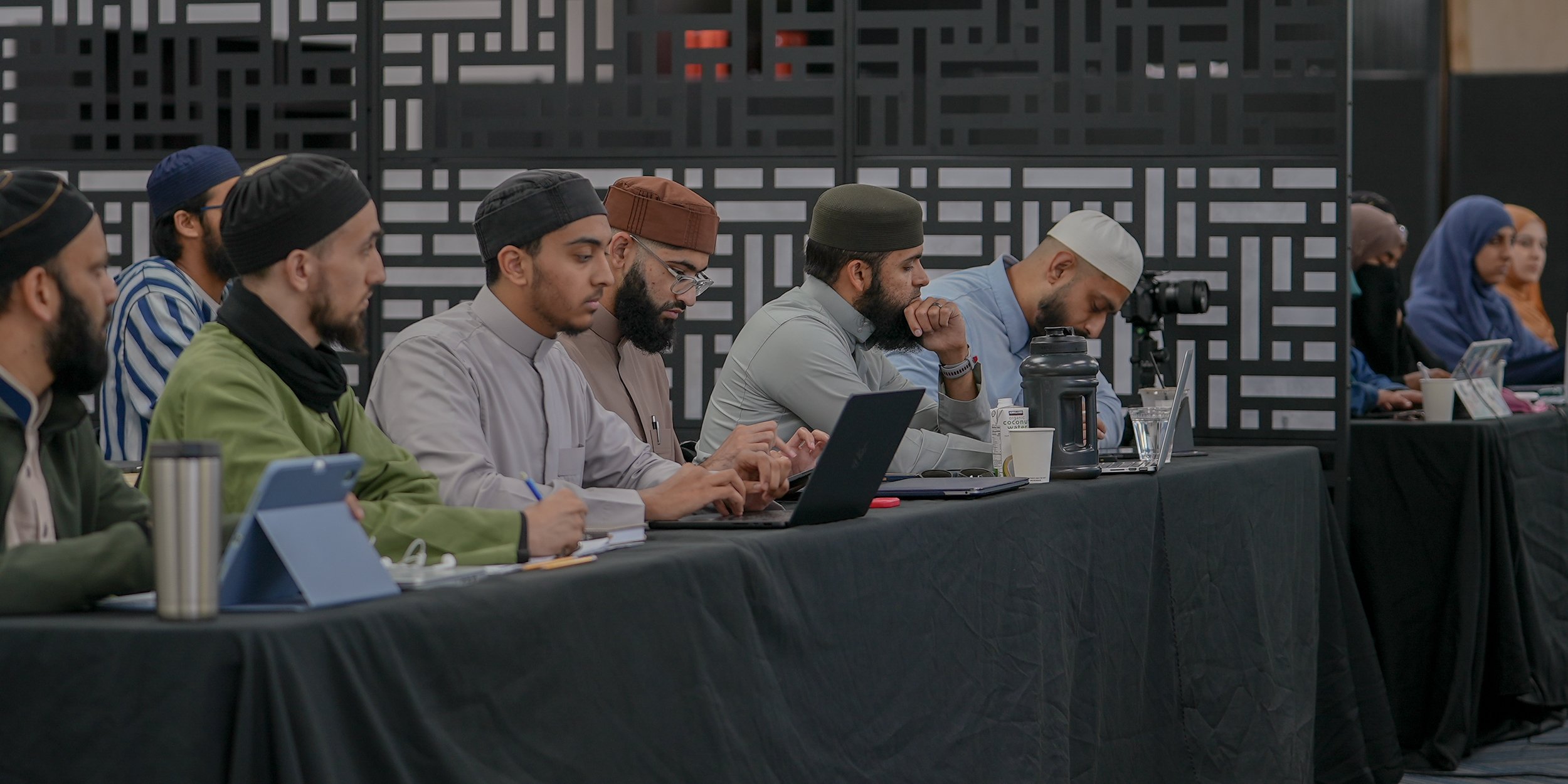
Takhaṣṣuṣ in Fiqh and Iftāʾ Program
Qalam Seminary is honored to introduce its Takhaṣṣuṣ Graduate Program, designed to help cultivate the next generation of religious, spiritual, and intellectual leaders for the American Muslim community. This initiative answers the growing call for leaders grounded in authentic Islamic scholarship and equipped to navigate the complexities and challenges of contemporary society. With the American Muslim population projected to nearly double by 2050, the need for sophisticated, knowledgeable, and accessible religious guidance has never been greater.
Our Takhaṣṣuṣ program is crafted to help students to master both an advanced body of knowledge as well as the practical skills associated with individual disciplines, for example those needed to become a mufassir, faqīh, or muḥaddith. In addition to academic excellence, the program also emphasizes spiritual mentorship, ensuring that graduates are not only learned, but that they also possess the wisdom, character, and judgment to serve as exemplary leaders and guides for the umma, insha’Allah.
Qalam’s initial offering of a Takhaṣṣuṣ in Fiqh and Iftāʾ provides advanced students a unique opportunity to delve deeply into the Islamic legal tradition, connecting the rich heritage of classical scholarship to contemporary questions and challenges. Students will explore the historical development of fiqh, the methods of giving fatwa, and cultivate the skills necessary for independent research and effective application of Islamic law with deep contextual understanding (tafaqquh).
Graduate Program Instructors
-

Shaykh AbdulNasir Jangda
-

Mufti Hussain Kamani
-

Mufti Muntasir Zaman
-

Shaykh Uwais Namazi
-

Dr. Salman Younas
INSTRUCTOR
-

Dr. Sam Ross
INSTRUCTOR & ADVISOR
Program Overview
The Qalam Seminary Takhaṣṣuṣ program is a part-time program which will require three years to complete. All students in the graduate program must complete 27 quarter-length courses to graduate.
Term Dates (10-Week Quarters)
Fall Quarter: August 24th, 2025 — November 29th, 2025
Winter Quarter: November 30th, 2025 — March 21st, 2026
Spring Quarter: March 22nd, 2026 — June 11th, 2026
Fiqh Lab and Reading (Year-Round): August 24th, 2025 – June 11th, 2026
Location: This is a hybrid program, offered in-person in Carrollton, Texas and online via Zoom.
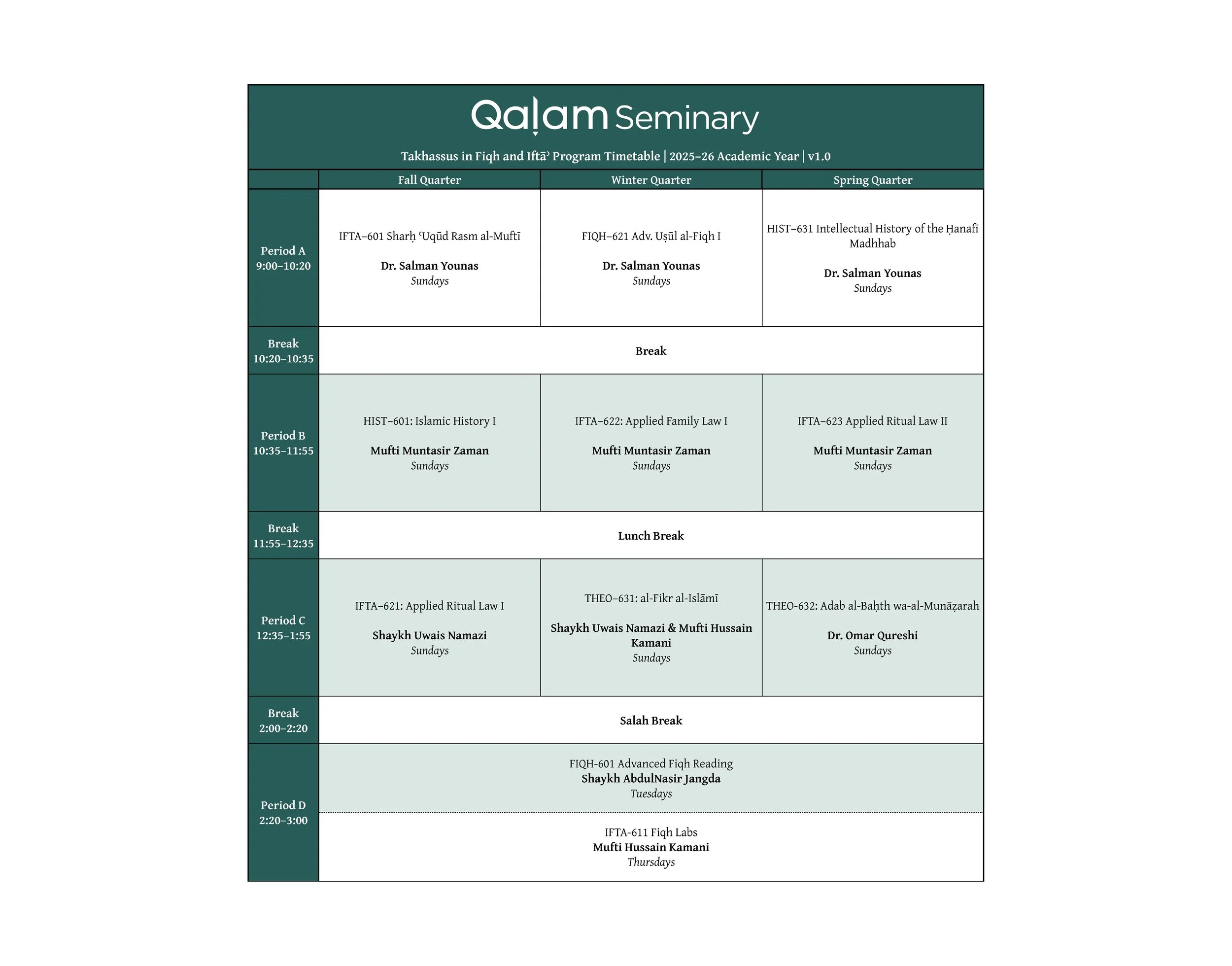
Weekly Schedule:
· Sunday Period 1: 9:00 am — 10:20 am Central US time
· Sunday Period 2: 10:40 am — 12:00 pm Central US time
· Sunday Period 3: 12:35 pm — 1:55 pm Central US time
· Tuesday Weekly Fiqh Reading Session: 2:20 pm — 3:00 pm Central US time
· Thursday Weekly Fiqh Lab: 2:20 pm — 3:00 pm Central US time
Note: This is a rigorous program, and students will be required to spend at least two hours on reading, homework, and revision per hour of instruction. The total commitment for class time and homework is therefore approximately 15 hours per week.

Curriculum Overview
2025–26 Academic Year Timetable
Admissions & Tuition
Space is limited to 12 students per cohort in order to ensure that students receive individualized attention. Students are admitted on a rolling basis, prioritizing early applicants.
Applicants must complete all steps of the application form and a multipart entrance exam. After a review of the application and entrance exam, shortlisted candidates will be invited to interview with a panel of faculty members.
Tuition (2025–26)
2025–26 Tuition: $5,100 ($1,700 per quarter)
Non-Refundable Enrollment Fee: $250
Scholarships: Generous need and merit-based scholarships are available.
Living Stipends: Need-based living stipends are available for zakat-eligible students.
Applications are currently closed! Fill out the interest form to be notified when our next cohort begins.

Takhaṣṣuṣ in Fiqh Course Catalog
Fiqh Practicum
The practicum courses are designed to develop students’ practical knowledge and experience navigating major reference works, serving the community, and gaining mentorship from experienced practitioners and teachers of Fiqh. Students will also be able to gain writing skills as they learn to effectively and accurately answer fiqh questions. The practicum courses involve:
· Reviewing relevant chapters of fiqh using medium-length canonical texts
· Answering regular fiqh questions
· Completing fiqh projects to refine their application skills, such as assessing contracts, surveying zakat agency models, and completing a portfolio project.
· Exploring relevant overlap or conflict with the American legal system
-
Course Title: Applied Ritual Law 1, 2 & 3
Instructor: TBA
Course Description: This series of courses will focus on the chapters of Ṭahārah, Ṣalāh, Zakāh, Ṣawm and Ḥajj, where students will:
· Draft several short, medium-length and essay length responses to real Fiqh inquiries.
· Study Zakāh distribution and agency models.
-
Course Title: Applied Family Law 1 & 2
Instructor: TBA
Course Description: This series of courses will focus on the chapters of Nikāḥ and Ṭalāq, along with coverage of the chapters on Raḍāʿah, ʿIddah and Ḥaḍānah. Students will:
· Draft short, medium-length and essay-length responses to Fiqh inquiries.
· Explore marriage and annulment contracts as well as valid and invalid conditions at a practical level.
· Engage with various writings to help deepen their understanding of applied family law in the contemporary context.
-
Course Title: Applied Transactional Law 1 & 2
Instructor: TBA
Course Description: This series of courses will focus on the chapters on transactions (muʿāmalāt). Students will:
· Draft short, medium-length and essay-length responses to Fiqh inquiries.
· Complete projects exploring various types of contracts as well as valid and invalid conditions at a practical level.
· Study of the AAOIFI standards.
· Completing a portfolio project to consolidate their learning.
-
Course Title: Applied Inheritance Law + Miscellaneous Issues
Instructor: TBA
Course Description: The first half of this course will cover the content in al-Sirājī fī al- Mīrāth along with extensive application of the learning, along with a study of the modern legal discussions, challenges and solutions. The remainder of this course will focus on various readings to increase the tafaqquh of students on key miscellaneous topics.
-
Course Title: Fiqh in the Community
Instructor: TBA
Course Description: This practical course is designed to cultivate the skills necessary for successfully serving and teaching in the community. Topics include key rulings on charitable work (ṣadaqah, zakāh, etc.), civic engagement, working with non-Muslim organizations, and addressing social issues through an Islamic legal framework. Students will also explore varied pedagogical methods and strategies for effectively teaching challenging and sensitive Fiqh topics in a community setting. Students will be required to teach an introductory Fiqh class in their local community, with regular opportunities to receive feedback from experienced instructors.

Theoretical Foundations of Fiqh
The theoretical foundations of Fiqh courses are designed to give students the frameworks to properly conceptualize fiqh and its discussions. Students will be able to study these topics with experts who have both academic and practical experience allowing the students to build a solid foundation alongside their practical training.
-
Course Title: Sharḥ ʿUqūd Rasm al-Muftī
Instructor: TBA
Course Description: A comprehensive study of the methodology of fatwā, including an introduction to the hierarchy of books and scholars within the Ḥanafī madhhab, determining the authoritative position, reasons for departure from the authoritative position, and the role of ʿurf, among other topics.
-
Course Title: Uṣūl al-Fiqh 1 & 2
Instructor: TBA
Course Description: This is a two-part Uṣūl al-Fiqh course series, focusing on a strong foundation in Ḥanafī Uṣūl al-Fiqh. In this series students will:
· Study select topics from the chapters of Kitāb and Sunnah, with a focus on discussions related to language and hermeneutics
· Discuss Ḥanafī approaches to hadith studies
· Study the chapters on qiyās, istiḥsān, ijtihad, taqlīd and other miscellaneous topics
· Build a nuanced and sensible approach to scholarship, adherence to madhhabs, talfīq and related issues
-
Course Title: Applied Qawāʿid with Nawāzil (including a study from Al-Ashbāh wa-l-Naẓāʾir)
Instructor: TBA
Course Description: A study of the qawāʿid ʿāmmah from Ibn Nujaym’s Al-Ashbāh wa-l-Naẓāʾir, along with case studies applying legal maxims to contemporary issues.
-
Course Title: Intellectual History of the Ḥanafī Madhhab
Instructor: TBA
Course Description: A detailed study of the the Ḥanafī madhhab across history, including the various sub-traditions and approaches to authority among Ḥanafī scholars.
-
Course Title: Juristic Authority across the Madhāhib
Instructor: TBA
Course Description: A study of how juristic authority is conceived across the other three madhāhib with experts from each madhhab, in addition to a detailed treatment of talfīq and modern conceptions of authority.
-
Course Title: Islamic Ethics (Fiqh as Tazkiyah)
Instructor: TBA
Course Description: A course on Islamic Ethics with readings in advanced uṣūl al-fiqh texts that focus on integrating ʿAqīda, Fiqh and Tazkiya. These readings will help to unlock the philosophical and spiritual ethics underpinning Fiqh, and touch on the principles of the genre known as Asrār al-Sharīʿah.
-
Course Title: The Qaḍāʾ System & al-Siyāsa al-Sharʿiyya
Instructor: TBA
Course Description: The first part of this course will study the qaḍāʾ system, its development and modern solutions for a post-qaḍāʾ world. The second part of the course will focus on the subject of al-Siyāsa al-Sharʿiyya (also known as Siyar). It will include a survey of selections from Imam Muḥammad b. al-Ḥasan al-Shaybānī’s Siyar works, along with a detailed theoretical treatment of the interaction between fiqh and siyāsa.

Classics
Classics courses offer students the opportunity to consolidate their ʿĀlimiyyah learning by reading great works of the Islamic tradition that integrate all of the ʿulūm that they have studied as well as model for students how to think profoundly and holistically about the “big questions.” While students begin these processes during their ʿĀlimiyyah years, post-graduate coursework in the Classics sequence will be an important capstone to their Fiqh training.
-
Course Title: Worldview Construction and Synthesis: Ḥujjat Allah al-Bālighah by Shāh Waliyy-Allāh al-Dihlawī
Instructor: TBA
Course Description: Ḥujjat Allāh al-Bālighah is the magnum opus of Shāh Waliyy-Allāh al-Dihlawī, one of the great intellectuals of the 18th century CE. One of its key features is its synthesis of creedal, legal and ethical-spiritual disciplines to achieve an integrated worldview. Through a study of selections from Ḥujjat Allāh, this course will expose students to the underlying wisdoms of the Sharīʿah as a whole and model how the full range of the Islamic Sciences can be brought together into a singular worldview.
-
Course Title: Depth of Legal Thinking: Al-Muwāfaqāt fī Uṣūl al-Sharīʿah of al-Shāṭibī
Instructors: TBA
Course Description: Al-Muwāfaqāt is a magisterial work of legal theory by the 8th century AH Mālikī jurist Abū Isḥāq al-Shāṭibī. This work draws upon both the Ḥanafī and Mālikī legal schools to develop the sub-discipline of the objectives of the law (maqāṣid al-sharīʿah). This course will cover the chapters on Maqāṣid al-Sharīʿah from al-Muwāfaqāt, providing students an opportunity to grow in the depth of their legal thinking and to better appreciate the connections between the letter and spirit of the law.
-
Course Title: Civilizational Studies and Critical Socio-Historical Analysis: Muqaddimat Kitāb al-ʿIbar of Ibn Khaldūn
Instructors: TBA
Course Description: The Prolegomena (al-Muqaddimah) is a landmark work by the 8th century AH North African historian and scholar Ibn Khaldūn, who is often considered the father of the social sciences. Brimming with political, economic, sociological, and historical insights, this “introduction” to his larger work of history advances numerous theories including his concept of “ʿaṣabiyyah” (social cohesion), the cycles of civilization, and the impact of geography on civilizational development. Students will analyze Ibn Khaldun’s theories and explore how his insights remain relevant to modern life.

History
The study of history is an essential complement for any specialization in fiqh, as it enables a scholar to contextualize pre-modern works, better understand their arguments, and responsibly apply the tradition to the present. It is also essential for leading the community. As Ibn Khaldun notes in his Muqaddima, “The discipline of history is a noble science, abundant in benefits, and lofty in its purpose. It acquaints us with the conditions of past nations … so that those who seek to emulate them, in matters of religion and worldly affairs, may do so with full understanding.” Scholars endowed with historical consciousness are also able to counter mistaken narratives, install pride in one’s forebears, perceive the forces shaping the present, and better anticipate the future.
-
Course Title: Pre-Modern Islamic History 632 – 1800 CE
Instructors: TBA
Course Description: This course examines the major developments in Islamic history from the passing of the Prophet Muhammad ﷺ in 632 to the decline of the Ottoman and Mughal empires circa 1800. It explores the expansion of Islamic civilization, the rise and fall of major dynasties, and the intellectual and spiritual contributions of Muslim scholars and institutions. All aspects of history will be engaged including its political, military, economic, social, artistic and cultural dimensions. The course also analyzes interactions between the Muslim world and other civilizations, including trade, diplomacy, and conflicts.
-
Course Title: Modern Islamic History 1800 CE – Present
Instructors: TBA
Course Description: This course explores the major events, trends, and developments that have shaped the modern Muslim world. It covers the impacts of colonialism, modern technology, reformist and revivalist movements, and the emergence of nation-states. Special attention is given to key Muslim scholars, institutions, and trends that have influenced modern Muslim thought. The course concludes addressing the challenges of modernity, globalization, and the potential futures of the Muslim world.
-
Course Title: Islam in the West
Instructors: TBA
Course Description: This course explores the history and dynamics of Muslims living as minorities in Western countries as well as the Western reception of Islam. Planned topics include: early contact, immigration and settlement patterns, conversion, identity formation, Islamophobia, assimilation and the intergenerational transfer of faith, institution building, Muslim contributions, and potential futures.

Enrichment
A variety of courses outside of the specialization area will be offered every year, enriching students’ educational experience. Students must take three enrichment courses to graduate. Enrichment courses may include Islamic Psychology, Adab al-Baḥth wa-l-Munāẓara, al-Fikr al-Islāmī, a second Islamic language and literature (e.g. Fārsī or Urdu), Biomedical Ethics, Commercial Ethics, Islam & Politics, etc.
Weekly Reading Sessions
As part of the Fiqh Takhaṣṣuṣ, students will have a weekly post-Ẓuhr session critically reading through Radd al-Muḥtār, the magnum opus of the Ottoman Ibn ʿĀbidīn (d. 1836 C.E.) with an instructor. This work is one of the great encyclopedic works of the late Ḥanafī Madhhab which collates and summarizes a significant portion of the scholarly output of prior centuries. To be able to access this text requires a guided reading course as students develop their ability to access Ibn ʿĀbidīn’s writing, in addition to learning how to critically benefit from and engage with his work. Participation in the weekly reading sessions is a mandatory component of the program.
Takhaṣṣuṣ FAQs
-
Our classes are conducted at the Qalam campus, which is located at 4200 International Pkwy, Carrollton, TX, 75007.
All classes are also offered online.
-
Qalam does not provide housing accommodations for students. However, upon admission, we provide a recommended list of apartment complexes, etc. in the area. We also put accepted students in touch with each other so that they may arrange roommates among each other.
-
This program is a part-time intensive program designed to accommodate students who are working full time.
-
All of our classes are available online for international students to benefit from. Please keep in mind, however, that classes are required to be attended live, so the student needs to take the time difference into consideration. All class timings are in Central Time (Dallas, TX).
Applicants applying from abroad may be granted admission as an in-person student. However, Qalam Institute does not currently assist in visa processing, nor do we have the authority to grant student visas. As such, the applicant must make their own legal and financial preparations to make the move and attend classes in-person.
-
Admissions are done on a semi-rolling basis, where applicants are accepted in waves. After completing all steps of the application process, you will receive further information. There will be constant communication throughout the entire process, inshaAllah.
-
Yes, Qalam does offer financial aid and scholarships. Details regarding financial aid are offered on a case-by-case basis upon admission to one of our programs.
We at Qalam believe that finances should never hinder someone from learning their deen. That's why we encourage you to apply regardless of your financial situation.
If you scroll up on this page, you will find a full breakdown of our tuition, as well as all the forms of assistance we provide.
-
The Takhaṣṣuṣ application fee will be waived until the early bird deadline, May 26th, 2025. It will be $25 afterwards.
If we are past that date, and the price of the application is a barrier for you to apply, please email admissions@qalaminstitute.org and we will do our best to accommodate.
-
Unfortunately we are not offering partial enrollment in the Takhaṣṣuṣ program at this time.
-
Please contact admissions@qalaminstitute.org